
On this page
What causes gutters to sag?
| Cause | How it happens | Fix |
|---|---|---|
| Spikes backing out | Wood swells and shrinks; nails lose grip | Replace with screwed hidden hangers |
| Wide hanger spacing | Gutter bends between fixings under load | Add hangers at about 2-foot spacing |
| Rotten fascia | Fasteners pull out of soft wood | Replace the board, then re-hang |
| Heavy debris | Wet oak leaves, acorns and needles add weight | Clean; consider guards |
| Ice | A glaze adds weight to every foot of gutter | Stronger hangers; check after ice storms |
| Ladders and limbs | Direct impact bends the gutter | Straighten or replace the section |
Why spikes fail in Raleigh's climate
| Term | What it means on a Raleigh house |
|---|---|
| Spike and ferrule | An older fastening: a long nail driven through the gutter and a sleeve into the fascia. Spikes back out as the wood swells and shrinks. |
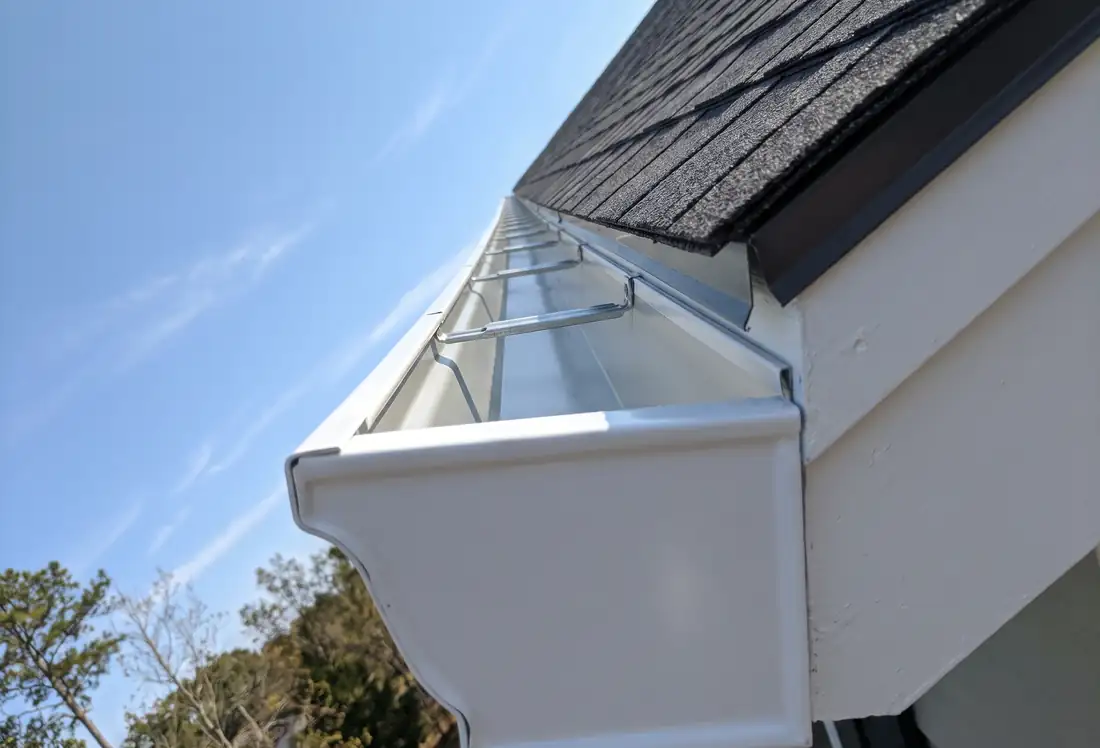
| Hidden hanger | A bracket that hooks under the gutter's front lip and screws through the back into the fascia. It replaces the old spike-and-ferrule fixings that work loose. |
| Fascia | The board fixed across the rafter tails, where most gutters are mounted. In a humid Piedmont climate, paint failure here lets the wood soften within a few seasons. |
Many Raleigh houses built before the 2000s still have their original sectional gutters hung on spikes and ferrules. A spike is just a long nail. Raleigh's humid summers swell the fascia, cooler dry winters shrink it, and over years each cycle loosens the nail a little more. Once a few spikes back out, the gutter sags at those points, water collects there, the extra weight pulls the next spikes, and the sag spreads.
Hidden hangers solve this. They hook under the gutter's front lip and are fixed with a screw through the back of the gutter into the fascia and, ideally, the rafter tail behind it. Screws hold far better than nails, and the hangers brace the gutter's shape.
What about the wood behind the gutter?
The most important check before re-hanging anything is the fascia. If a screwdriver or awl sinks easily into the wood, a new hanger will pull out just like the old spike. Rot is common on older houses where gutters have overflowed or held water for years. The fix is to remove the gutter, cut out the rotten section, install new fascia, ideally wrapped in aluminum trim coil, and then re-hang. The fascia and soffit page explains that work.
How is slope restored?
A gutter needs a slight, steady fall to its outlet, commonly about a quarter inch over 10 feet. When a gutter sags, the slope is broken: water runs toward the low spot instead of the downspout. Re-hanging involves snapping a chalk line along the fascia at the correct fall, then lifting the gutter to that line and fixing a hanger every 2 feet or so. On long runs, the contractor may re-pitch the gutter to drain both ways to downspouts at each end.
When is a sag a sign of a bigger problem?
- When the gutter has sagged in several places at once.
- When the fascia is soft along whole sides of the house.
- When the gutter metal itself is kinked or stretched.
- When it is a sectional gutter whose seams also leak.
Then a replacement with seamless gutters on new hangers, over sound fascia, usually gives a better result than chasing individual sags. The repair or replace guide helps decide.
How to spot a sag early
After rain, look along each gutter from the end. Water standing in the gutter, a visible dip in the line, or a gap between the gutter's back and the fascia are early signs. During rain, a single point where water spills over the front, away from any corner, usually marks the bottom of a sag.
Sagging gutters: what Raleigh homeowners ask
| Question | Short answer |
|---|---|
| Is a slight sag a problem? | Yes if water stands there. Even small sags hold water that adds weight and rots wood. |
| Can sagging be fixed from a ladder? | Usually. The gutter is lifted to a chalk line and re-fixed with new hangers. |
| Will new hangers damage the gutter? | No. Hidden hangers clip inside the gutter and screw through the back. |
| Why did my gutter sag after an ice storm? | Ice weight pulled spikes or hangers out of the fascia. |
Where around Raleigh does this come up?
| Neighborhood or town | Why it matters there |
|---|---|
| Garner | Spike-hung gutters on older ranches |
| Glenwood-Brooklyn | Old frame houses with soft fascia |
| Zebulon | Heavy leaf loads from big trees |
Getting ready for the visit
Look along each gutter from the corner of the house and photograph any dips. Note whether the gutter has spikes visible on its face; that tells the contractor what fastening is there now.